Gonna Be A Rough Ride This Week

Share prices on Bursa Malaysia are likely to be higher next week on the back of positive corporate data as well as the government's initiatives in boosting the economy and with the market abuzz with talks on privatisation which kept interest positive.
On external factors, the direct impact of other global markets on the country would be minimal as Bursa Malaysia was quite resilient compared to other regional bourses. He expected the support level next week to be at 1,320 and the next resistance level at 1,350. For the week just-ended, the key FBM KLCI rose 2.57 points to 1336.65.

Share prices on Bursa Malaysia rose a for a second week, lifting the blue-chip benchmark index to a two-month high while small-cap stocks staged a strong comeback by late week as retail participation in the sector picked up after a month-long absence due largely to the Fifa World Cup distraction.
The 30 blue-chip benchmark FTSE Bursa Malaysia Kuala Lumpur Composite Index (FBM KLCI) climbed 12.34 points, or 0.93 per cent last week to settle at 1,336.65, with Axiata (+11 sen), Maybank (+12 sen), Public Bank (+16 sen), Tenaga (+16 sen) and Sime Darby (+10 sen) contributing to three quarters of the index's increase.
The Finance Index advanced 148.94 points to 12,100.61, Plantation Index increased 15.56 points to 6,289.50 and the Industrial Index rose 21.18 points to 2,655.03. Total volume for the week rose to 3.40 billion shares worth RM5.94 billion from 2.81 billion shares worth RM5.02 billion last week.
The daily slow stochastics indicator for the FBM KLCI crossed for a sell signal deep in the overbought zone, implying weakness ahead, which is further reinforced by a similar sell signal on the weekly indicator triggered in the overbought region.
However, the 14-day and 14-week Relative Strength Index (RSI) climbed higher towards the 60 reading, suggesting improving upside momentum. Meantime, the daily Moving Average Convergence Divergence (MACD) signal line expanded higher following last week's buy signal, while the weekly MACD signal line has hooked up to indicate improving upside potential. Meanwhile, the +DI and -DI lines on the 14-day Directional Movement Index (DMI) indicator sustained a bullish expansion, but the ADX line weakened to suggest a weakening uptrend.
The daily slow stochastics indicator for the FBM KLCI crossed for a sell signal deep in the overbought zone, implying weakness ahead, which is further reinforced by a similar sell signal on the weekly indicator triggered in the overbought region.
However, the 14-day and 14-week Relative Strength Index (RSI) climbed higher towards the 60 reading, suggesting improving upside momentum. Meantime, the daily Moving Average Convergence Divergence (MACD) signal line expanded higher following last week's buy signal, while the weekly MACD signal line has hooked up to indicate improving upside potential. Meanwhile, the +DI and -DI lines on the 14-day Directional Movement Index (DMI) indicator sustained a bullish expansion, but the ADX line weakened to suggest a weakening uptrend.

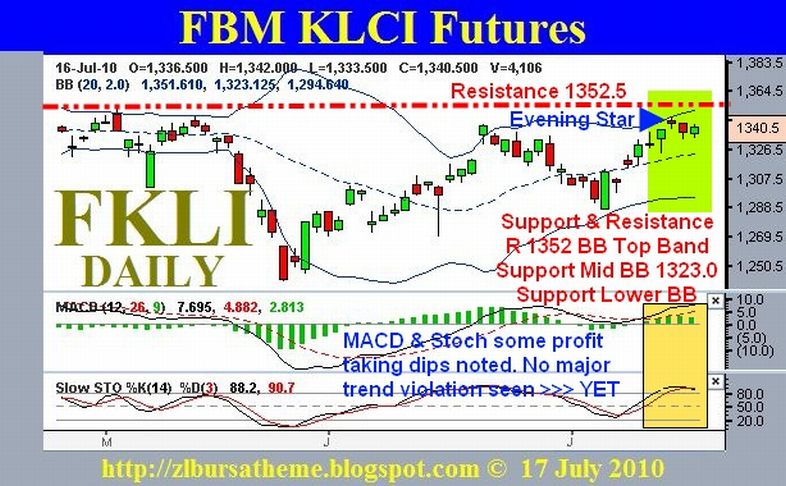
Spot month July KLCI futures contract traded on Bursa Malaysia Derivatives was up 12 points or 0.9 per cent week-on-week to 1,340.5 for a slightly lower 3.85 point premium to the cash index, compared with the 4.19 point premium the previous Friday.
FKLI August, September and December each increased three points to 1,340, 1,339 and 1,338.5, respectively.
Turnover, however, declined to 4,545 lots from 7,695 lots on Thursday while open interest rose to 19,958 contracts from 19,344 contracts on Thursday.
Turnover, however, declined to 4,545 lots from 7,695 lots on Thursday while open interest rose to 19,958 contracts from 19,344 contracts on Thursday.
 The above FKLI Monthly Chart shows a distinctive Cup & Handle formation but be reminded since that is a monthly chart, be ready for a lot of rumbles & tumbles in-between . The longterm outlook os optimistically positive for FKLI.
FKLI Recommendations
BUY ON DIPS & SUDDEN SELLDOWNS


 DJIA Drops 261 Points on Surprise Consumer Confidence Plunge
 By the time the dust settled, the Dow Jones Industrial Average (DJIA – 10,097.90) was sitting on a drop of 261.4 points, or 2.5%. The blue-chip barometer ended below its 10-day and 20-day moving averages for the first time since July 6, as all 30 of its components fell. Bank of America led the pack with a 9.2% plunge, while American Express (AXP), Cisco Systems (CSCO), Home Depot (HD) and GE all shed more than 4%.


 Crude futures followed suit with stocks today, ending with a thump in the wake of troubling economic news. Traders panned uninspiring manufacturing reports from the New York and Philadelphia Federal Reserve Banks, and news of China's year-over-year decline in second-quarter gross domestic product only served to heighten concerns about the state of the global economy. However, crude's losses were minimized by the day's not-so-bad report on jobless claims, along with the U.S. dollar's weak showing versus the euro. Crude oil for August delivery gave up 42 cents, or 0.6%, to finish at $76.62 per barrel.
 On the other hand, gold futures capitalized on the market's jittery mood. A negative session for stocks, along with the greenback's decline against the euro, helped the malleable metal attract a few buyers today. Gains were muted, though, as traders seemed unwilling to make any big moves ahead of tomorrow's report on consumer-level inflation. August-dated gold futures ended the day with a gain of $1.30 at $1,208.30 per ounce.


